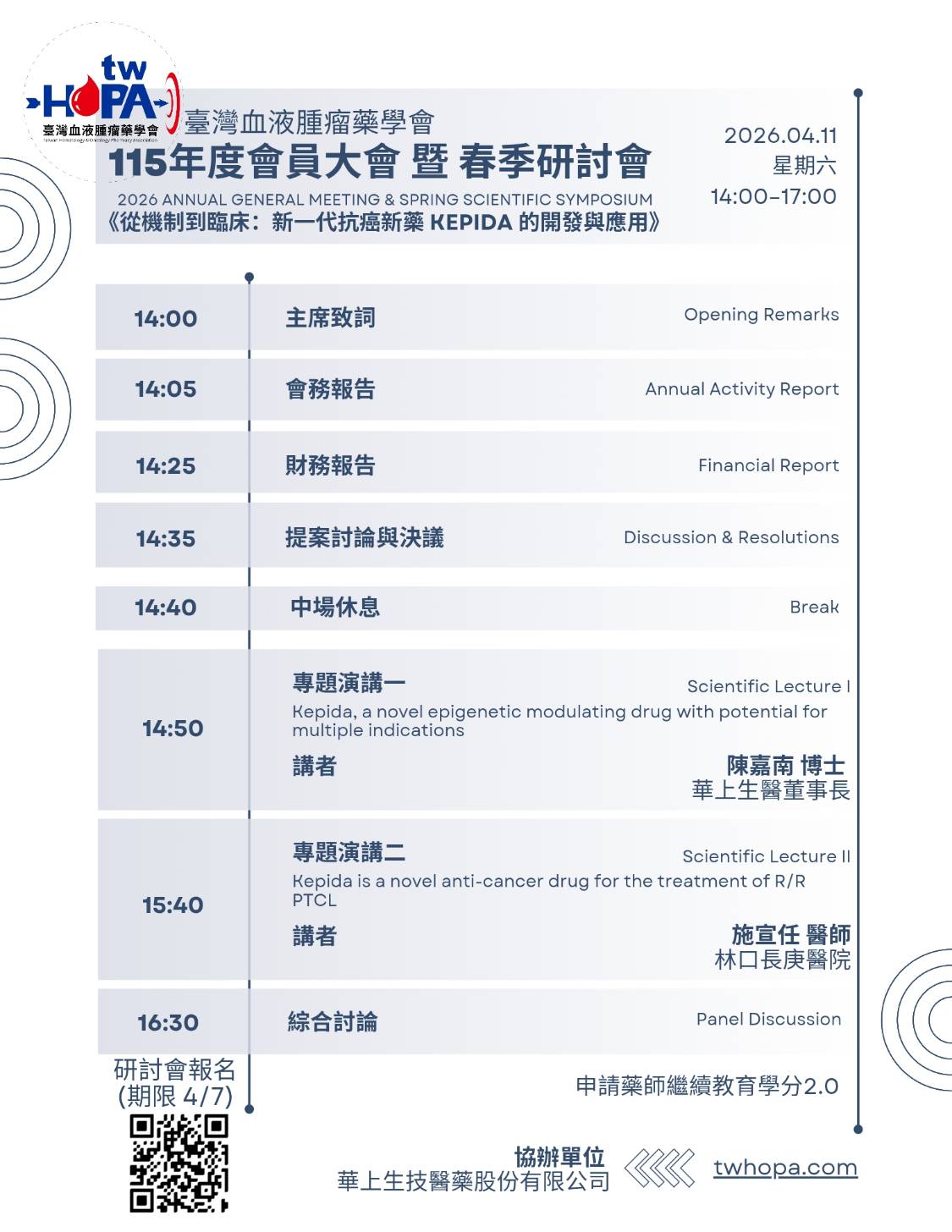
選單 研討會快訊 最新醫療快訊 藥物安全警訊 學會行事曆 115年度台灣血液腫瘤藥學會會員大會暨春季研討會 2026-03-23 查看更多 Upcoming ASHP On-Demand Activities Upcoming ASHP On-Demand Activities FEATURED ON-DEMAND RESOURCES View all recorded webinars → This educational activity will include evidence-based care and best practices for identifying and addressing barriers and social determinants of health that impact CKM syndrome. The latest evidence focused on the use of SGLT2 inhibitors on cardiovascular and kidney outcomes will be discussed and applied to individualized patient cases. New Release! CE Webinar This educational activity discusses the pathophysiology of Chronic Inflammatory Demyelinating Polyneuropathy as well as the incidence, prevalence, clinical course, and burden of disease. A review of the current guideline-recommended therapies will be discussed, including any treatment limitations. New Release! CE Webinar This educational activity will present the cardiovascular risks of CKD and discuss approaches to identify and screen patients at risk for CKD. Real-world examples of best practices in multidisciplinary care and patient education will be shared to equip and inspire pharmacists to bridge gaps across the cardiovascular-kidney-metabolic spectrum. New Release! CE Webinar This educational program reviews root causes and economic factors that contribute to sterile injectable supply disruptions and drug shortages and provides collaborative solutions for supply availability and ensuring long-term sustainability. New Release! 2026-03-05 查看更多 New! Free Parenteral Nutrition Quality and Safety On-Demand CE Just Released! Free On-Demand Patient Safety CE on Parenteral Nutrition Parenteral nutrition (PN) is a life-sustaining intervention for patients unable to receive oral or enteral nutrition. Compounding of PN involves many steps that can be labor intensive to ensure that PN is accurately and aseptically produced. An approach to improving standardization to reducing errors and patient harm is through greater use of multi-chamber bag parenteral nutrition (MCB-PN). MCB-PN requires less preparation time and labor, leads to a reduction in errors, may reduce the risk of infectious complications leading to a reduction in the length of hospitalization, and is associated with a significant cost benefit compared with compounded PN. MCB-PN reduces the compounding required by pharmacists but still allows for the addition of additives prior to administration. This educational activity will discuss appropriate patient selection for multi-chamber bag parenteral nutrition (MCB-PN) and how to safely prepare and dispense MCB-PN. This activity will also use a case-based approach to illustrate strategies to reduce the risk of errors and improve patient care in various practice settings. The activity will highlight the important role of the pharmacist in parenteral nutrition, including in healthcare settings without formal nutrition support teams. We invite you to share this free educational activity with your colleagues. PharmD, BCNSP, FMSHP, FASHP, FASPEN Activity Chair Clinical Manager Mississippi Baptist Medical Center Clinical Associate Professor University of Mississippi School of Pharmacy Jackson, Mississippi PharmD, BCCCP, BCNSP, BCPS, FASHP, FASPEN, FCCM, FCCP Chair and Clinical Professor Philadelphia College of Pharmacy Saint Joseph's University Philadelphia, Pennsylvania This activity was planned to meet the educational needs of pharmacists in leadership positions including pharmacy executives, managers and supervisors, front-line clinical pharmacists and those in product procurement roles who can identify specific opportunities for multi-chamber bag parenteral nutrition (MCB-PN). Welcome and IntroductionsPhil Ayers Parenteral Nutrition and the Important Role of Multi-Chamber Bag Parenteral Nutrition (MCB-PN) Phil Ayers and Angela Bingham Interactive Case Presentations and Discussion: Safety First! Effectively Using MCB-PN All Faculty Pharmacist Involvement in Nutrition in a Practice Setting Without a Nutrition Support Service All Faculty Faculty Discussion, Questions and Answers All Faculty ACPE #: 0204-0000-25-413-H05-P CE Credit: 1.5 contact hours (0.15 CEUs) Activity Type: Application-based Activity Fee: No charge Available: February 26, 2026 - February 26, 2027 To receive CE credit, complete the steps below within 60 days of completing the activity. After the 60-day deadline, ASHP will no longer be able to report credit(s). To view all of the live activities offered in person and online, click here. 2026-02-28 查看更多 Free CE Sounds Good to Me! Learn LDL-C and ASCVD Risk and Improve Patient Outcomes with PCSK9 Inhibitors Newly Released Free, On-Demand CE! Pharmacists can bridge the gap in ASCVD care with lipid screening, optimization of LDL-C lowering medication therapy, and improving medication adherence. In this program, experts will review updated guideline recommendations for ASCVD risk assessment and treatment; explore statin and nonstatin medications including current and emerging PCSK9 inhibitors; describe strategies for overcoming barriers to achieving LDL-C thresholds; and expand on strategies for increased patient engagement and shared decision-making to optimize outcomes. We invite you to share this free educational activity with your colleagues. PharmD, FASHP, MNLA, BCPS, BCACP, Activity Chair Associate Dean for Clinical Affairs, Professor, Department of Clinical Pharmacy; Professor, Department of Family Medicine Skaggs School of Pharmacy and Pharmaceutical Sciences, University of Colorado Anschutz Medical Campus Aurora, Colorado PharmD, BCPS, CLS, FNLA, FASPC Clinical Pharmacist, General Cardiology Knight Cardiovascular Institute, Oregon Health & Science University Portland, Oregon This activity was planned to meet the educational needs of pharmacists who practice in hospitals, health systems, specialty pharmacies, ambulatory clinics, and community settings who manage patients at high risk for ASCVD or who have clinical ASCVD. Analyze the role of LDL-C in ASCVD and the importance of achieving LDL-C thresholds to reduce the risk of ASCVD events. Prioritize lipid screening and risk stratification for patients at high risk for ASCVD and with clinical ASCVD, including patients with heterozygous familial hypercholesterolemia, at-risk populations, and patients with high unmet needs. Examine benefits and risks of current and emerging LDL-C lowering pharmacotherapies. Apply current guideline-based recommendations to the treatment of patients at high risk for ASCVD and with clinical ASCVD who are eligible for nonstatin therapies including PCSK9 inhibitors. Welcome and IntroductionsJoseph Saseen Overview of Atherosclerosis Bruce A. Warden Evidence-based Management of Hypercholesterolemia Joseph Saseen Statin and Nonstatin Medications Joseph Saseen Achieving Recommended LDL-C Thresholds to Reduce ASCVD Event Risk Bruce A. Warden Faculty Discussion, Questions and Answers All Faculty ACPE #: 0204-0000-25-417-H01-P CE Credit: 1.5 contact hours (0.15 CEUs) Activity Type: Application-based Activity Fee: No charge Available: February 19, 2026 - February 19, 2027 To receive CE credit, complete the steps below within 60 days of completing the activity. After the 60-day deadline, ASHP will no longer be able to report credit(s). 2026-02-26 查看更多 New Release! Free Pulmonary Arterial Hypertension On-Demand CE Just Released! Free, On-Demand CE on PAH Navigating the Complex Landscape of Pulmonary Arterial Hypertension: A Roadmap for Pharmacists The last 30 years have seen significant advances in the diagnosis, treatment, and management of pulmonary arterial hypertension (PAH). Improvements in understanding the pathways underlying endothelial dysfunction and vascular arteriole remodeling involved in the pathogenesis of PAH, targeted therapies, and enhanced diagnostic and monitoring tools are reflected in new evidence-based guidelines. This educational activity will present the latest guidelines and recommended treatment options for PAH, including drug selection, combination therapies, and when and how to adjust and escalate treatment. This activity will also discuss drug therapy mechanisms of action, potential interactions, adverse effects, and considerations to support access and adherence. We invite you to share this free educational activity with your colleagues. Featuring... PharmD, BCCPActivity Chair Clinical Pharmacy Specialist– Cardiology Cardiology Pharmacy Residency Director Advocate Health – Aurora St. Luke's Medical Center Milwaukee, Wisconsin PharmD, BCCP, BCPS, BCACP, CPP Cardiology Pharmacist Cardiology Pharmacy Residency Program Director Atrium Health Wake Forest Baptist Winston Salem, North Carolina Target Audience Learning Objectives Agenda Welcome and IntroductionsJared Frost Pathophysiology and diagnosis of pulmonary arterial hypertension (PAH) Zachary Klick Guidelines and Evidence-based Treatment of PAH Jared Frost Therapy Considerations for PAH All Faculty Faculty Discussion, Questions and Answers All Faculty Accredited for CPE ACPE #: 0204-0000-25-409-H01-P CE Credit: 1.5 contact hours (0.15 CEUs) Activity Type: Application-based Activity Fee: No charge Available: February 19, 2026 - February 19, 2027 To receive CE credit, complete the steps below within 60 days of completing the activity. After the 60-day deadline, ASHP will no longer be able to report credit(s). To view all of the activities offered online, click here. 2026-02-25 查看更多 Now Available! Free, On-Demand CE on Incorporating Guideline-Based Recommendations to Identify and Manage Chronic Kidney Disease Now Available On-Demand! Free CE on CKD Most patients with chronic kidney disease (CKD) are unaware they have it. Guidelines have established well-known risk factors for CKD to help identify and screen patients, but many patients remain unscreened and untreated. Untreated CKD can lead to kidney disease progression, cardiovascular disease, morbidity, and mortality. As the most accessible healthcare professionals, pharmacists often interact with patients at risk for CKD when managing their chronic disease care or medications, uniquely positioning pharmacists to identify and screen patients at risk for CKD. Pharmacists can ensure patients are receiving guideline recommended care for CKD to improve outcomes and reduce cardiovascular risks. Pharmacists can also bridge care for patients with CKD and other cardiovascular-kidney-metabolic conditions through multidisciplinary collaboration and holistic care. This educational activity will present the cardiovascular risks of CKD and discuss approaches to identify and screen patients at risk for CKD. Patient cases will be utilized to illustrate the appropriate guideline-recommended care of CKD. Real-world examples of best practices in multidisciplinary care and patient education will be shared to equip and inspire pharmacists to bridge gaps across the cardiovascular-kidney-metabolic spectrum. We invite you to share this free educational activity with your colleagues. PharmD, BCACP, FNKF, FASN, FCCPActivity Chair Professor and Chair, Department of Pharmacy Practice Albany College of Pharmacy and Health Sciences Albany, New York PharmD, BCACP, BCGP, BC-ADM, CDCES Clinical Assistant Professor - Long Island University, Arnold & Marie Schwartz College of Pharmacy and Health Sciences Ambulatory Care Clinical Pharmacist - One Brooklyn Health, Pierre Toussaint Health Center Brooklyn, New York This activity was planned to meet the educational needs of pharmacists who practice in hospitals, health systems, community pharmacies, and ambulatory clinics who care for or are interested in the care of patients with chronic kidney disease. Welcome and IntroductionsKatie Cardone Identifying Patients and Providing Guideline-Based Screening for CKD Katie Cardone Simplifying the Guidelines and Clinical Evidence to Provide Optimal Care for Patients with CKD Lavinia Salama Interprofessional and Holistic Care in CKM Syndrome All Faculty Faculty Discussion, Questions and Answers All Faculty ACPE #: 0204-0000-25-415-H01-P CE Credit: 1.5 contact hours (0.15 CEUs) Activity Type: Application-based Activity Fee: No charge Available: February 19, 2026 - February 19, 2027 To receive CE credit, complete the steps below within 60 days of completing the activity. After the 60-day deadline, ASHP will no longer be able to report credit(s). 2026-02-24 查看更多 Around the World: 24-Hour Virtual Symposium – What to Expect A global community of oncology pharmacy practitioners striving to advance cancer care Around the World: 24-Hour Virtual Symposium What to Expect With just 42 days to go until the Around the World: 24-Hour Virtual Symposium, I am delighted to share more detail about what the 24 hours will include, with you choosing when and how often you join. The Symposium has been designed as a 24-hour experience to ensure members around the world—regardless of time zone—can participate in live sessions and networking opportunities. Alongside the plenary sessions (outlined below), participants will have access to regular networking opportunities through themed roundtable discussions in breakout rooms. These sessions will take place during scheduled breaks, giving participants the flexibility to rest, stretch, or join a conversation. Topics will span professional interests—such as biosimilar implementation and getting started in research—as well as lighter and wellbeing-focused themes, including hobbies like canoeing or badminton (to get to know each other), and discussions on managing workload and burnout. These roundtables aim to foster meaningful connections, encourage collaboration, and expand your global professional network. The program will also feature 12 plenary presentations, showcasing the highest-rated abstracts across four different time zones—highlighting the best of ISOPP’s global expertise. Registration is just 30 CAD, making this an accessible and sustainable learning opportunity for members worldwide. We encourage you to register and to share this event with colleagues on line and on socials. Your support will be instrumental in ensuring success. #ISOPP2026. Program* highlights include: *subject to change We look forward to welcoming you online for this truly global Symposium. 2026-02-06 查看更多 Connect With ER-Positive/HER2-Negative MBC Patients to Improve Care Patient-centric strategies in ER-positive/HER2-negative MBCEducation AlertCommunicating to Enhance Care Through Data and Patient Experience: ER-Positive/HER2-Negative Metastatic Breast Cancer Edition0.50 CME / CE / ABIM MOC Did you know that benefits of transitioning from fulvestrant to oral SERDs are fewer clinic visits and more patient independence? 2026-01-27 查看更多 123